

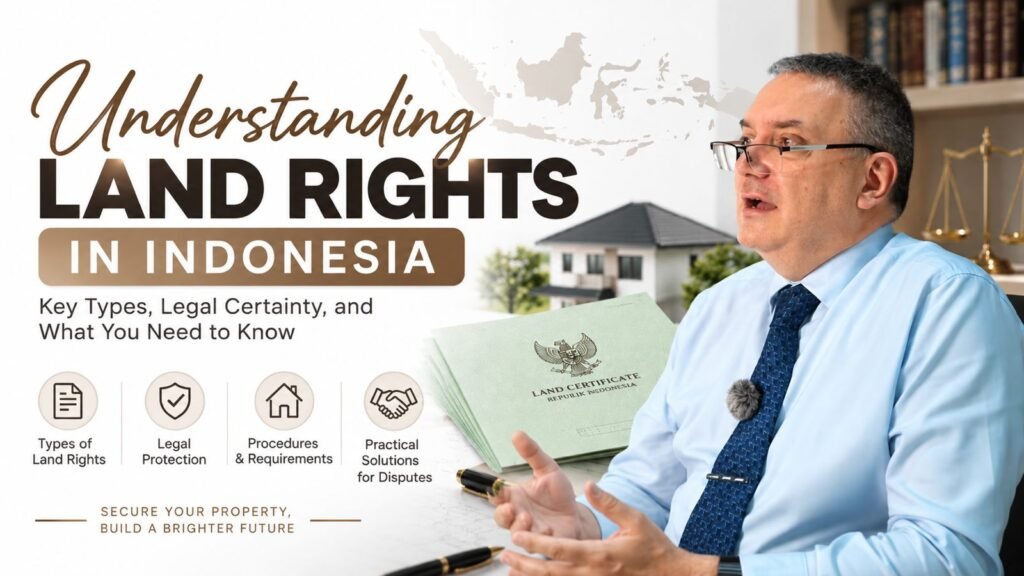
The Question That Almost Always Comes First
orlovlegal.com — ALMOST every foreigner who starts seriously considering living or investing in Bali eventually lands on the same question: can I actually own land here? The answer often gets flattened into a simple yes or no, when in reality it sits somewhere in between, depending on which type of right is involved and how the process is carried out.
Oleg Orlov, an advocate at PT Southeast Partnership Indonesia, hears this question from clients all the time. His short answer is a useful starting point before diving into paperwork and notaries:
“As always, the devil is in the details — what exactly do you mean by ‘buy’? It really depends on the land’s legal status.”
Here is the order a foreigner usually needs to follow before actually holding rights to a piece of land in Bali — laid out as practical steps, not just legal theory.
The Steps, in Order
1. Start by understanding there are five types of land rights in Indonesia
Before talking about price or location, get familiar with the legal framework first. “If you read the Basic Agrarian Law, you’ll find there are several types of land rights in Indonesia: freehold title (hak milik), right to use (hak pakai), right to build (hak guna bangunan), cultivation right (hak guna usaha), and lease right (hak sewa),” Oleg explains. Each of these five rights carries different legal weight and comes with its own rules, and the most important first step is figuring out which one actually applies to your plans.
2. Accept the limitation up front: freehold title is closed to foreigners
This is usually the part that disappoints people early on, so it’s better understood from the start. “When we talk about the strongest, purest right — freehold title — foreigners simply cannot buy land in Indonesia under that right. That includes companies too. Even if just one percent of a company’s shares are foreign-owned, that company can no longer buy land under freehold title,” Oleg states firmly. Once this limitation is clear in your mind, the next steps become easier, because you’re no longer chasing something that was never on the table.
3. Shift your focus to right to use or right to build
This is where the real door opens. “When we talk about other rights, like right to use or right to build, those are permitted. Foreigners can acquire land under right to use, but there are limitations attached — a time limit, a minimum land value, a maximum land size, and so on,” Oleg explains. Generally, right to use is granted for a fixed period and can be extended, with additional requirements such as holding a valid residence permit (KITAS/KITAP) and the property value meeting a minimum threshold set by the local government.
4. Consider the lease option too, but understand how it differs
There’s another path that’s sometimes mistaken for right to use, even though it’s quite different. “Foreigners can also hold land under a lease right, but that’s very different from right to use,” Oleg says. A lease right is essentially closer to a time-bound contractual agreement between tenant and landowner, rather than a registered property right like right to use. It’s more practical and quicker to arrange, but its legal standing is also weaker.
5. Check that your personal documents are in order before moving further
Once you know which type of right you’re aiming for, the next matter is documentation: a valid residence permit (KITAS or KITAP), official identification, and clear proof of the source of your funds. Each type of right comes with its own administrative requirements, and having these documents in order is usually what determines whether the process runs smoothly or stalls halfway through.
6. Don’t skip the step of consulting a lawyer who understands the situation on the ground
Because every case has its own details — as Oleg puts it, “the devil is in the details” — this step really shouldn’t be skipped. Consulting a lawyer experienced in cross-border property transactions, such as the team at PT Southeast Partnership Indonesia, helps ensure the rights structure you choose actually fits your goals, whether that’s long-term residence, running a business, or simply passive investment.
7. Only then move on to the notary and official registration process
Once the legal structure is settled and the documents are complete, the process moves on to a notary/PPAT for drafting the deed, followed by registration with the local National Land Agency (BPN). This stage usually moves faster precisely because every step before it was done correctly.
Why the Order Matters
Many land ownership problems involving foreigners in Bali don’t actually stem from bad intentions — they stem from doing things in the wrong order: people pay for and take control of the land first, then only later look into its legal status. Following the sequence above from the start, and getting proper guidance on how to own land in Bali as a foreigner, can significantly reduce the risk of disputes or transactions that end up legally void. (*)
Every case has different details, and the type of right that works for one person may not work for another. The team at PT Southeast Partnership Indonesia (Oleg Orlov) is ready to help with further consultation.
WhatsApp: +62 821-4500-5544